My neurodiversity and SEND resources are designed to explain key ideas clearly and accessibly, with a focus on understanding how learners may experience communication, attention, sensory processing, literacy and the demands of education.
The collection includes guides on autism, dyslexia, monotropism and autistic processing. They are intended for teachers, tutors, parents and others who want a practical introduction to these areas without reducing complex experiences to a list of behaviours or assumptions.
GCSE Study Skills and Revision
GCSE Study Skills Workbook for Autistic and Neurodivergent Students
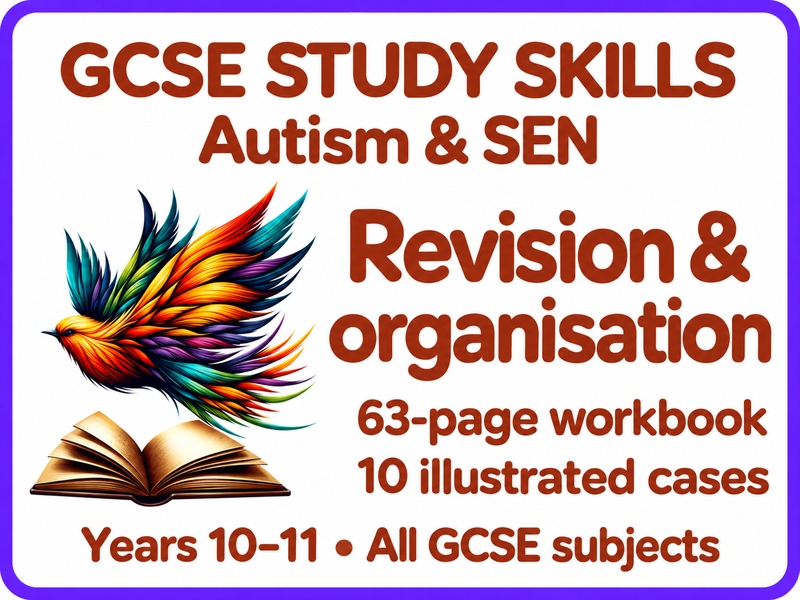
A 63-page workbook supporting GCSE revision, organisation, planning and executive functioning for students in Years 10 and 11, across GCSE subjects.
Ten fictional student scenarios, illustrated with stick-figure comic strips, provide practical problems to investigate. Students explore what is getting in the way, consider possible responses and then develop tools they can use in their own revision. Guided questions move from noticing specific details towards problem-solving, personal reflection and trying a strategy.
The cases cover getting started, prioritising subjects, understanding feedback, knowing when to stop, managing sensory demands and fatigue, adapting disrupted plans and preparing for mocks. Reusable planning pages, guidance for supporting adults and optional suggested responses are included.
Suitable for supported work in one-to-one tuition, mentoring, SEND provision and home education.
Autism and Autistic Processing
Understanding Autistic Processing
A clear introduction to some of the ways autistic people may process information, communication, sensory input and demands differently.
The guide is designed to help readers look beyond surface behaviour and consider what may be happening underneath it. It can be useful for teachers, tutors and parents who want to understand why a learner may need more processing time, clearer expectations, reduced sensory load or a different route into a task.
Understanding Monotropism
An accessible introduction to monotropism and its relevance to autistic attention and experience.
The guide explores the idea that attention may be concentrated deeply on a smaller number of interests or demands at one time, and considers how this can affect transitions, interruptions, task-switching and engagement.
It is intended to help readers understand monotropism as a way of thinking about attention rather than simply viewing intense focus or difficulty switching tasks as a problem to be corrected.
Autism in Girls
Autism in Girls
A guide exploring some of the ways autism may present in girls and why autistic girls can be missed or misunderstood.
The resource considers masking, social expectations and the tendency for autistic traits to be interpreted differently in girls. It is designed to support greater awareness among teachers, tutors and parents, particularly where a learner appears to be coping outwardly while experiencing significant effort or difficulty underneath.
Dyslexia
Understanding Dyslexia
A practical introduction to dyslexia and the ways it can affect reading, spelling, writing and the processing of written language.
The guide is intended to help readers understand dyslexia in a broader way than simply associating it with spelling mistakes or letter reversals. It can be used as a starting point for thinking about the kind of explicit teaching, repetition and structure some learners may need.
Understanding the Learner Behind the Task
The same classroom task can place very different demands on different learners. A piece of writing may involve idea generation, language formulation, handwriting or typing, spelling, working memory, planning and managing uncertainty at the same time. A verbal instruction may require listening, processing, holding information in memory and beginning a task before the learner has fully understood what is expected.
My wider teaching approach is shaped by the idea that difficulty with a task does not always tell us which part of the task is creating the barrier. Breaking demands down more carefully can make it easier to identify where support is needed and to choose a response that is proportionate to the learner.
The aim of these guides is therefore to support understanding rather than provide a fixed checklist for what an autistic or dyslexic learner will look like. Individual learners can have very different strengths, difficulties and support needs.
Inclusive Teaching Resources
Many of my English and literacy resources are also designed with accessibility in mind. They use clear instructions, manageable stages, modelling and repeated practice to reduce unnecessary cognitive load while keeping the underlying learning objective intact.
These resources may be useful for autistic learners, learners with dyslexia, students who experience anxiety around open-ended tasks and others who benefit from more explicit structure.
Browse GCSE English Language resources →
Browse Functional Skills English resources →
Browse Literacy and Phonics resources →
More from Kate Coldrick
I also write about autism, inclusion, assessment and education on my main website, including longer articles exploring the experiences of neurodivergent learners and the practical implications for teaching.

